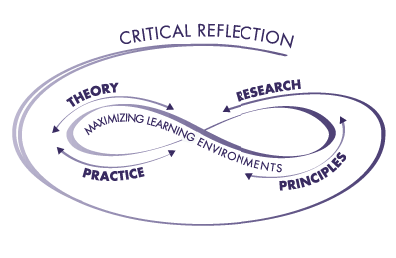
We approach our educational consulting work by applying the guidelines of the TRPP model to maximize the learning environment. TRPP is a model that we developed and published in 1996. It is based on the integration of Theory, Research, Principles and Practice.
We bring our clients an up-to-date understanding of the most current theory and research related to teaching and learning. One of our first actions is to form a guiding coalition of individuals across the organization. This group helps provide us with the pulse of the internal community. We facilitate the work of this team and collaborate to develop a process or product that is relevant to the organization. We work with the team to integrate external research with the data we collect across the organization. Then we collaborate to develop a set of evidence-based principles that will ensure sustainable best practice for that particular learning environment.
Our work is customized depending on the organization’s needs but is always informed by theory and research that lead to principles and practice.
The TRPP Model
Our approach uses the TRPP Model to find solutions across higher education and provides the foundation for an integrated plan for achieving best practices.
Theory provides the foundation for solving problems and facing challenges. It leads to critical reflection and a better understanding of complex situations.
Example: A significant premise in social-cognitive and self-efficacy theory is that individuals have specific beliefs about their ability to successfully perform certain tasks. These beliefs affect their behavior. Albert Bandura and others have found individuals' self-efficacy plays a major role in how goals, tasks, and challenges are approached.
Research confirms the way to solve problems and suggests new ways of thinking. Research findings and active engagement in research lead to best practice without reinventing the wheel.
Example: Carol Dweck's research examines self-conceptions (mindsets) people use to structure and guide their behavior. In particular, she focuses on how mindsets influence motivation and self-regulation and how this impacts achievement and interpersonal interactions.
Dweck's research revealed two different mindsets: Fixed mindsets and growth mindsets.
A fixed mindset is the belief that talents and abilities are set and not open to change.
A growth mindset is the belief that talents and abilities are developed as a result of dedication and hard work. www.mindsetonline.com
TRPP: A Model for Change Martha E. Casazza and Sharon L. Silverman South African Journal of Higher Education (1999)
Principles of best practice guide what we do and integrate knowledge from different sources.
Example: Individual achievement is facilitated when self-efficacy beliefs are most closely connected with realistic assessments of ability. In this situation, a growth mindset is developed.
Best Practice results from critical reflection of theory and research applied to our work. We revisit and examine long-standing practices.
Example: Assessing the mindset of an individual is a significant component of the learning process. With individuals who have fixed mindsets, we create challenging opportunities to promote movement toward a growth mindset. This is accomplished by working with students to develop new approaches to successful learning.