TRPP Associates
  • HOME
  • WHAT WE DO
    • Our Work >
      • Conference Presentations and Key Notes
      • International Projects and Presentations
      • Publications
      • Program Development and Redesign
      • Webinars and Podcasts
      • Research
    • Our Philosophy
    • TRPP Innovation Award
  • WHO WE ARE
    • Dr. Sharon Silverman
    • Dr. Martha Casazza
  • WHY CHOOSE US
    • Our Clients
  • STUDENT VOICES
  • BLOG AND PODCASTS
  • CONTACT

PROGRAM EVALUATION Module Five - TRPP Talks - A Series of Podcasts

4/20/2017

8 Comments

 
Picture
Welcome to the last module in our series on Program Evaluation.  In Module Five, you will hear how to organize and share the results of your evaluation.

We look forward to hearing from you and hope you've enjoyed this series!


The evaluation template is provided here again for your use as you conduct your own evaluation.

template-1.docx

Click on this link to hear Module Five.

trppassociates.podbean.com/e/program-evaluation-module-five-trpp-talks-a-series-of-podcasts/


8 Comments

PROGRAM EVALUATION Module Four - TRPP Talks - A Series of Podcasts

2/28/2017

6 Comments

 
Picture

Welcome again to TRPP Talks and the fourth in a series of five podcasts on program evaluation.  We hope you enjoyed the first three modules.  Now,let's move ahead.

Click on this link to hear MODULE FOUR.

trppassociates.podbean.com/e/trpp-associates-trpp-talks-program-evaluation-module-four/?token=a4e5c523f8df936538c2f09bda62c7da

Click on this link to see the Program Evaluation Template.

template.docx

Click on this link to use the Blank Program Evaluation Template and complete Steps 8 and 9.

blank_action_plan_template.docx

Post your questions, comments, and responses as a comment.  We look forward to reading them and giving feedback as requested

6 Comments

PROGRAM EVALUATION Module Three   TRPP Talks - A Series of Podcasts

2/25/2017

7 Comments

 
Picture


Welcome again to TRPP Talks and the third in a series of five podcasts on program evaluation.  We hope you enjoyed the first and second modules.  Now,let's move ahead.

Click on this link to hear MODULE THREE.

trppassociates.podbean.com/e/program-evaluation-module-three-trpp-talks-a-series-of-podcasts/?token=a7580f45c218608ed3947b362990269d


Click on this link to see the Program Evaluation Template.


template.docx

Click on this link to use the Blank Program Evaluation Template and describe how you will address Steps 5, 6 , and 7.

blank_action_plan_template.docx

Post your questions, comments, and responses as a comment.  We look forward to reading them and giving feedback as requested


7 Comments

PROGRAM EVALUATION Module Two:  TRPP Talks - A Series of Podcasts

1/27/2017

8 Comments

 
Picture


Welcome again to TRPP Talks and the second in a series of five podcasts on program evaluation.  We hope you enjoyed the first module and have successfully completed steps one and two.  Now that you've identified who will support the process and who will lead it, let's move ahead.

Click on this link to hear Module Two.

trppassociates.podbean.com/e/trpp-associates-presents-trpp-talks-program-evaluation-steps-three-and-four/?token=40def11ebb

Click on this link to see the PROGRAM EVALUATION TEMPLATE - Steps Three and Four

action_plan_for_a_systematic_program_evaluation.docx

Click on this link to use the PLANNING TEMPLATE - Steps Three and Four and describe how you will address Steps Three and Four. 

blank_action_plan_template.docx


Post your questions, comments, and responses as a comment.  We look forward to reading them and giving feedback as requested.

8 Comments

PROGRAM EVALUATION Module One:  TRPP Talks - A Series of Podcasts 

1/20/2017

5 Comments

 
Picture

Welcome to the TRPP Talks series on Program Evaluation! 

We are pleased to present the first module in a series of five podcasts on Program Evaluation. Each podcast presents two or three steps of the ten step approach to systematic program evaluation.  This approach is based on the work of Dr. Rosemary Caffarella in her book Planning Programs for Adult Learners.

After listening to the podcast, please use the Program Evaluation Template to describe how you will address Steps One and Two and post your response as a comment here.  We look forward to your response and will provide feedback as requested.  Post your questions/comments here or email us at [email protected].


Click on this link to hear the first podcast - PROGRAM EVALUATION - STEPS ONE AND TWO

trppassociates.podbean.com/e/trpp-associates-presents-trpp-talks-program-evaluation-steps-one-and-two/


Click on this link to see THE PLANNING TEMPLATE - STEPS ONE AND TWO.

program_evaluation_action_plan_template_-_steps_one_and_two.docx


Click on this link to use the Planning Template and describe how you will address Steps One and Two.

program_evaluation_action_plan_template_blank.docx


5 Comments

Social Media and Academic Self-Efficacy

5/11/2016

35 Comments

 
Are your students overly active on social media? Do you wonder about social media and its effect on academic performance and self-efficacy beliefs?

Current research on higher education reveals that students who multitask with Facebook and texting do not stay well engaged in learning. When these students find they have not learned well, they believe they don't have the capacity to succeed and experience lower levels of academic self-efficacy (Junco, 2012).

A recent study examined college students' use of social media and academic self-efficacy beliefs. This study concluded that "students who spend a lot of time on social media also have lower academic self-efficacy beliefs, GPAs, and satisfaction with life" (Hassell & Sukalich, 2015).

What is your experience? How do you handle social media usage with your students? What interventions can be used to address the negative relationship between social media usage, academic performance and self-efficacy?

Hassell, M.D. & Sukalich, M.F. (2015). Digging deeper into the outcomes of social media use among college students: The mediating effect of academic self-efficacy. Twenty-First Americas Conference on Information Systems, Puerto Rico.

Junco, R. (2012). The relationship between frequency of facebook use, participation in facebook activities, and student engagement. Computers & Education, 58 (1), 162-171.
35 Comments

What are we measuring?

4/11/2016

2 Comments

 
In a recent New York times interview, Angela Duckworth asserts that measuring grit" beats the pants off I.Q., SAT scores, physical fitness and a bajillion other measures to help us know in advance which individuals will be successful in some situations." In our recent research project, "Student Voices" we found that students who faced significant barriers but met their academic goals all exhibited grit among other "soft" skills. If we had assessed them simply on their standardized test scores or high school gpa's, we might have predicted that they would not make it to college graduation. They all did make it.

Duckworth has developed a grit scale which has proven to predict outcomes such as graduation. Sample items from the scale include, "I have overcome setbacks to conquer an important challenge," Setbacks don't discourage me," and "I finish whatever I begin." Duckworth also recommends that to foster grit, parents must be "really, really demanding, and be very, very supportive." We could translate those words to the work we do as learning assistance practitioners and developmental educators: We set rigorous standards for our students, and we create a strong support system to facilitate their achievement.

Do you think that administering the grit scale and then discussing it with students would help foster achievement? Would it be a base from which to teach them what grit is all about? How would it help us in the field of learning assistance and developmental education?
2 Comments

Meaningful Access and Success: Social-Emotional Competencies

3/3/2016

3 Comments

 
Two weeks ago in our blog, we talked about one of the elements (growth mindset) from our latest research project, "Student Voices." We interviewed students around the world who faced significant barriers but succeeded in reaching their goals. We discovered that at the core of their success was having someone who believed in them at a critical time. Significantly, our research also identified three components that were all correlated to this core: emotional awareness, persistence, and self-efficacy.

I think we all understand how important these are as separate and distinct attributes, but our research showed that they really represent a constellation of factors that are connected. For instance, we talk about growth mindset as one piece of the persistence component which also includes grit and resilience. Within the self-efficacy component, we discovered the importance of Bandura's determinants of personal and vicarious experiences, verbal messages and physiological states. The emotional awareness component includes the concept of emotional intelligence and its reliance on self-awareness, self-management, social awareness and social skills. These social-emotional competencies were significant for all our students who achieved success despite huge barriers.

A national teacher survey conducted in 2013 found that 93% of teachers think it is important to promote social-emotional competencies. In addition, 95% of teachers believed that these skills are teachable. Carol Dweck (2011) has asserted that these competencies may matter more than cognitive factors.

Recently schools have begun to measure these competencies; however, there is much controversy swirling around the idea. Federal education law now requires states to include one nonacademic measure to judge school performance. In California, 20% of the schools have chosen four measures to evaluate: growth mindset, social awareness, self-efficacy and self-management. This learning will contribute 8% of the school's overall performance score. This initiative has become controversial. Some say that it risks "blaming the victim" who may come from an underserved population and thus comes to school with an added disadvantage.

Given the considerable evidence that these competencies do have an effect on achievement and success and that they are teachable, do you think we should be evaluating our students on them? Do you think that measuring our students' progress in part on the development of social-emotional skills is important? Do you teach and/or assess students in these areas?

Let's talk.
3 Comments

Meaningful Access and Success: A Growth Mindset

2/18/2016

11 Comments

 
Picture
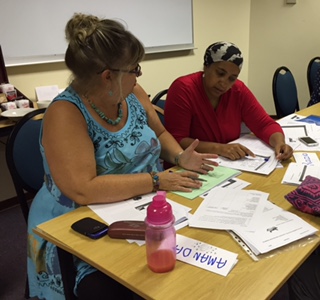
Students in South Africa actively engaged in team project.
My colleague, Sharon Silverman, and I have been interviewing university students who faced significant barriers such as inadequate academic preparation, lack of financial support, misconceptions about college and being a first generation student. Despite these obstacles, the students were all able to successfully achieve their goals, and we wanted to identify the factors that may have contributed to their success. We discovered that the most significant factor in their success was having someone who believed in them. This was the primary driver, but there were several personal attributes that were correlated to this. One of the strongest was the presence of a growth mindset.

Research indicates that mindset is a reliable predictor of academic performance. According to Carol Dweck (2006), there are two types of mindset: fixed and growth. With a fixed mindset, one believes they have been endowed with an intelligence that does not change over time. A growth mindset, on the other hand, leads one to believe that their behavior impacts their intelligence and ability to achieve. They see intelligence evolving over time through their efforts and strategic behavior. Each of the students we interviewed exhibited a growth mindset. We asked them to respond to Dweck's four basic statements (p.12) related to mindset:
  • Your intelligence is something very basic about you that you can't change very much.
  • You can learn new things, but you can't really change how intelligent you are.
  • No matter how much intelligence you have, you can always change it quite a bit.
  • You can always substantially change how intelligent you are.

When we presented the students with these options, 100% of them chose the last statement. One of them told us, "Intelligence to me is your ability to focus on learning the task at hand. Many people have that ability, but some people choose not to use it...you have some students that are not doing well in class, but they know the name of every song out there. They're intelligent in that realm...so I disagree that intelligence is fixed."

This leads us to believe that we need to be fostering the development of this mindset in our classrooms. What challenges do you see with the mindsets of your students? How do you promote growth mindsets with your students?

Please join the conversation and help us explore instructional principles and strategies in our practice that will promote the development of a growth mindset.
11 Comments
    About Our Blog and Podcasts

    We invite you to interact with us and your colleagues as we share ideas to enhance student learning and persistence.  We look forward to your active engagement.

    Subscribe to our Mailing List

    * indicates required

    Categories

    All
    Growth Mindset
    Meaningful Access & Success
    Social-Emotional Competencies

    RSS Feed

Proudly powered by Weebly
Live Chat Support ×

Connecting

You: ::content::
::agent_name:: ::content::
::content::
::content::